
Banyule City Council: Connecting Economic Development to Community Wellbeing
Banyule City Council had been running three separate strategies covering economic development, social enterprise and inclusive local jobs. Reviews of all three showed significant overlap and, more importantly, an opportunity: to stop treating economic growth and community wellbeing as separate agendas and bring them together. Council decided to consolidate the three into a single Inclusive Economy Strategy, repositioning the local economy as a vehicle for inclusion, participation and long-term resilience across the municipality.
It was an ambitious move, and not a simple one. An inclusive economy strategy has to hold two things that often pull in opposite directions: the hard edge of economic development, with its focus on investment, jobs and business growth, and the goals of social inclusion, reaching the people the economy usually leaves behind. Landing a single framework that served both, held a range of stakeholders together and worked within existing council budgets and a tight timeline was the real challenge.
I was engaged across two stages. In the first, I worked with Council’s Local Economy team to turn an extensive evidence base, including community consultation data from more than 200 sources, market research, an economic resilience report and reviews of the existing strategies, into a single strategic framework, with a detailed action plan and a monitoring and evaluation framework. I facilitated a workshop to test and sharpen the direction, and designed actions that strengthened existing programs rather than relying on new funding Council didn’t have.
One of the most important things I did was look past the averages. At the municipality level, Banyule’s employment figures looked healthy. But disaggregating the data told a very different story. By suburb, pockets of concentrated wealth and high employment sat alongside areas with large new migrant and refugee populations, lower education, lower income and significantly lower employment. Breaking it down further, by gender, disability and other diversity cohorts, surfaced barriers the headline numbers had hidden, affecting young people, women, people with disability and Aboriginal communities. Those insights shaped the strategy’s priorities directly.
In the second stage, I analysed feedback from a four-week public exhibition of the draft, prepared a public-facing engagement report, and updated the strategy and action plan. Feedback from the Wurundjeri Woi-wurrung Cultural Heritage Aboriginal Corporation was a key input, and I worked with the team to strengthen the strategy’s commitments to Aboriginal economic development, including a new objective and a set of near-term actions framed around partnership, with room to grow over the life of the strategy.
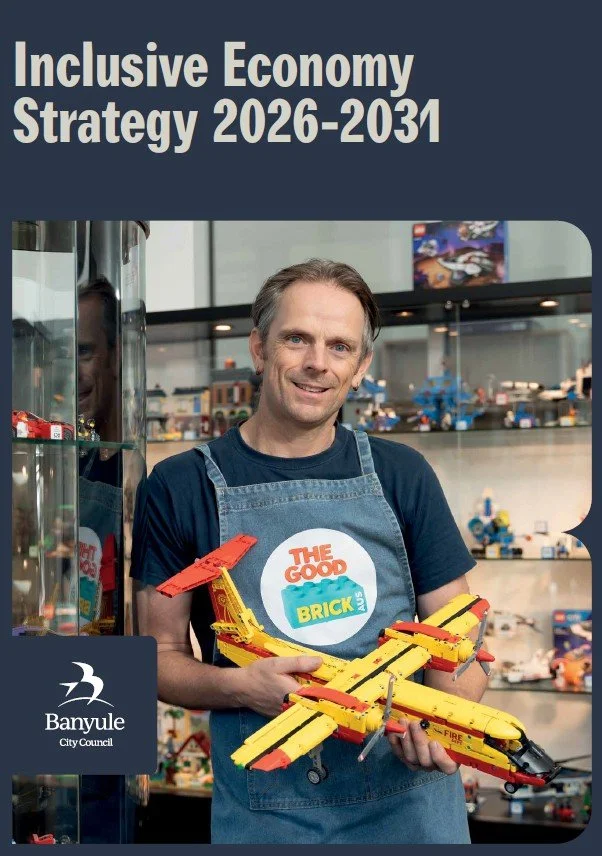
Council endorsed the Inclusive Economy Strategy 2026–2031 on 25 May 2026. It sets a target of 4,000 inclusive economic opportunities over five years, spanning jobs, employment pathways, business support, social enterprise and Aboriginal business growth, and gives Banyule a practical, evidence-based roadmap connecting economic development to community wellbeing, health equity and self-determination. Banyule is now one of the first councils in Victoria to adopt an inclusive economy framework of this kind, and the work is already reaching a wider audience: Council recently presented the strategy at a national Economic Development Australia webinar on putting inclusive economic development into action.
Read the final strategy on Banyule City Council’s website here.
“Olivia helped us bring together three separate strategies into a single, cohesive framework that really reflects our commitment to community wellbeing and an inclusive local economy.
She went above and beyond — not just delivering the strategy, but genuinely shaping its direction, challenging our thinking and helping us land on a framework that made sense for where we are and where we want to go.
The quality of the writing was excellent and we didn’t need to make any changes, which was incredibly valuable given our tight timelines and resourcing changes within the team. Her responsiveness and ability to keep things moving was a huge help.
I’d highly recommend Impact Practice to any council looking for strategic, purpose-driven consulting support.
”